

How It Works
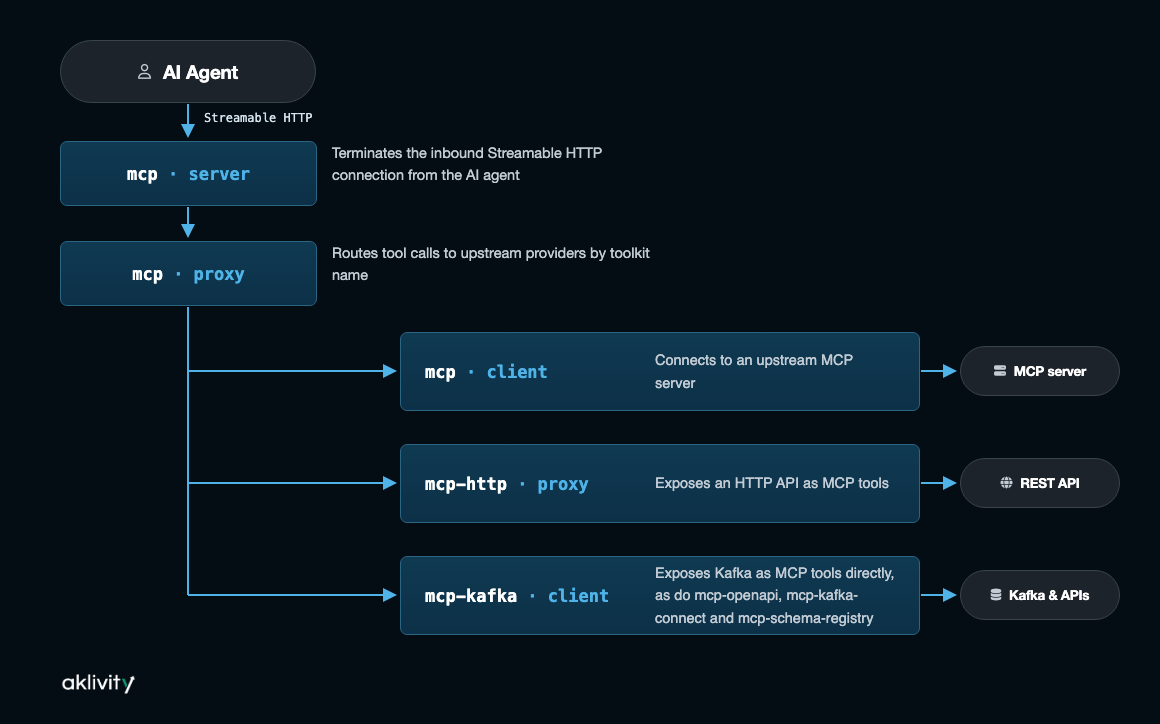
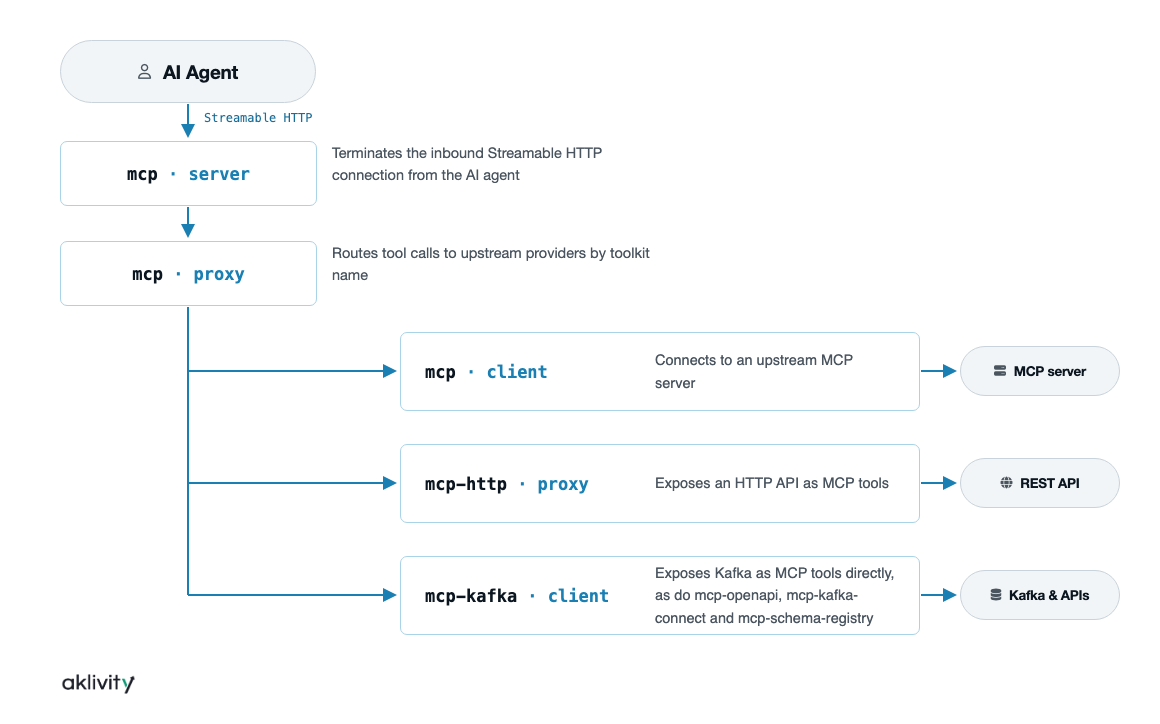
Zilla's MCP Gateway is built from a small set of composable bindings. Each layer does exactly one thing — and they chain together to form a complete gateway pipeline.
Binding Pipeline
| Binding | Role |
|---|---|
mcp · server | Terminates the inbound Streamable HTTP connection from the AI agent |
mcp · proxy | Routes tool calls to upstream providers by toolkit name |
mcp · client | Connects to an upstream MCP server over HTTP, WebSocket, or SSE |
mcp-http · proxy | Exposes any HTTP API as MCP tools with no MCP server needed upstream |
mcp-openapi, mcp-kafka, mcp-kafka-connect, mcp-schema-registry | Client-kind bindings that connect straight to a backend, with a compiled or built-in tool set and no upstream MCP server (see Backend Bindings) |
Request Flow
- The AI agent opens a Streamable HTTP connection to
mcp · server. mcp · serverforwards the session tomcp · proxy.mcp · proxyinspects the toolkit prefix on each tool call and routes to the matching exit binding.mcp · clientexits connect upstream MCP servers over HTTP.mcp-http · proxyexits call REST APIs directly.mcp-openapi,mcp-kafka,mcp-kafka-connect, andmcp-schema-registryexits connect straight to their backend, no upstream MCP server or hand-authored tool list required.- Responses are aggregated and returned to the agent as a unified MCP response.
Tool listing calls (tools/list, prompts/list, resources/list) are handled by the cache layer in mcp · proxy before reaching any upstream — see Listing Cache.